 Canada
 United States
Comparison
Pond De-Icer vs Aerator: Which One Your Fish Actually Need in Winter
A de-icer opens a hole in the ice but adds little oxygen. An aerator adds oxygen and helps hold a hole open, for a fraction of the running cost. Here is how to choose.
Last updated August 31, 2026
A de-icer keeps a hole open in the ice but adds little oxygen, while an aerator adds oxygen and, with a bottom diffuser, also helps hold a hole open. For fish, oxygen is the priority, so an aerator usually does more. A de-icer draws hundreds of watts and a diffuser only a few, so aeration costs far less to run.
The short answer: two different jobs
When your pond is about to freeze over, it is easy to assume a de-icer and an aerator do the same thing. They do not. A de-icer (sometimes called an ice eater or pond heater) has one job: keep a small patch of the surface open so trapped gases can escape and fresh air can reach the water. A winter aerator has a different job: push a steady stream of tiny bubbles up from the bottom to raise dissolved oxygen throughout the water column, which is what actually keeps fish alive under ice.
For most stocked ponds, the deciding factor is fish survival, and fish do not die because the surface froze. They die because dissolved oxygen ran out beneath the ice. That single fact is why an aerator usually does more of what you actually need, and why it costs far less to run. If you would rather have our team match a system to your pond and climate, ask our pond experts for a free recommendation.
Fish do not suffocate because the surface froze. They suffocate because oxygen ran out under the ice.
Why oxygen, not open water, is the real winter problem
In summer, algae, muck, and organic sediment build up on the pond bottom. When ice and snow seal the surface for the winter, two things happen at once. Photosynthesis stops or slows dramatically because light is blocked, so the pond stops making oxygen. Meanwhile that bottom sediment keeps decomposing, and decomposition consumes oxygen. The result is a slow, invisible drawdown of dissolved oxygen through the coldest weeks of the year, and eventually a winterkill.
The root cause frame matters here: excess nutrients like phosphorus and nitrogen, low dissolved oxygen, and an anaerobic bottom layer are what drive algae, muck, odor, and fish kills in the first place. Winter simply removes the pond's ability to compensate. A de-icer opening a hole does very little about the oxygen that is quietly disappearing below. An aerator addresses it directly. For the full winter playbook, see our guide on how to prevent winter fish kill.
Penn State Extension and other extension programs are clear on the mechanism: winterkill is an oxygen problem, and keeping a hole open helps most when it is paired with a way to actually move and oxygenate the water. That is the practical difference between the two tools.
How a de-icer works, and what it does not do
A floating de-icer or ice eater keeps a patch of water ice-free using either a heating element or a small propeller that agitates and circulates surface water. It is genuinely useful for one thing: guaranteeing an open hole even in brutal, dead-calm cold, when off-gassing and a bit of air exchange are all you are after.
But here is what a de-icer does not do:
- It adds little dissolved oxygen to the water column. Keeping a surface hole open is not the same as oxygenating the deep water where fish overwinter.
- It does not meaningfully heat the pond. Most de-icers keep a small area ice-free with a heating element or agitation, they do not warm the water column, so do not expect a warmer pond.
- It draws hundreds of watts continuously through the coldest months, which shows up on your power bill.
- It works only at the surface, so the anaerobic bottom sediment driving your oxygen demand goes untouched.
None of that makes a de-icer useless. In extreme climates it is a sensible insurance policy for keeping a hole open. It is just the wrong tool if your goal is keeping fish alive, because it treats the symptom (frozen surface) rather than the cause (falling oxygen).
How a winter aerator works, and its oxygen advantage
A winter aerator uses a compressor on shore to send air down to a bottom diffuser, which releases a column of fine bubbles. Two things happen as those bubbles rise. First, they carry oxygen into the water and, just as importantly, the rising column lifts warmer bottom water toward the surface and keeps the water gently circulating. That circulation is what tends to keep a hole open naturally, and it raises dissolved oxygen through the whole column rather than just at the surface.
This bottom-up, diffused approach is why aeration outperforms surface-only methods for destratification and oxygen delivery. Instead of scratching the surface, it works the entire depth of the pond. Explore purpose-built winter aeration systems if you want continuous, weather-independent oxygen through the season.
One honest caveat we will always give you: an aerator can help keep a hole open, but it cannot be promised to keep an entire pond surface open, and no aeration system guarantees against winterkill. In very cold snaps, or with heavy snow load, the open area can shrink. That is exactly why some owners in harsh climates run an aerator for oxygen and a de-icer to guarantee the hole. More on that pairing below.
The slow-start rule that protects your fish
If you are adding aeration to a pond that has been sitting stratified, do not switch it on at full output in deep winter. Bringing cold, oxygen-poor bottom water up too fast can cause a sudden turnover that stresses or kills fish, the opposite of what you want. Start slowly, run a diffuser set shallower than the deepest point, and build up circulation gradually. Our winter guide walks through keeping a hole open safely.
The running-cost reality: a few watts vs hundreds of watts
This is where the comparison stops being close. A bottom-diffuser aerator moves air with a small compressor and draws only a few watts of power to deliver oxygen across the whole pond. A de-icer, by contrast, typically draws hundreds of watts continuously all winter to keep one patch of surface open. Over a full cold season, that difference in draw adds up to a meaningful gap on your electricity bill.
| Function | De-icer / ice eater | Aerator (bottom diffuser) |
|---|---|---|
| Opens a hole in the ice | Yes, its main job | Yes, helps hold a hole open (not guaranteed in extreme cold) |
| Adds dissolved oxygen | Little, surface only | Yes, throughout the water column |
| Circulates the water column | No, surface agitation only | Yes, bottom-up destratification |
| Typical power draw | Hundreds of watts | A few watts |
| Heats the water | No | No |
| Best for | Guaranteeing an open hole in extreme cold | Keeping fish alive with continuous oxygen |
So for the same or lower upfront investment, an aerator does the more important job (oxygen) and the secondary job (helping hold a hole open) at a fraction of the running cost. That is the core reason we steer most fish-pond owners toward aeration first.
When to run both together
There is a legitimate case for running a de-icer and an aerator side by side, and it comes down to climate and risk tolerance. In harsh, prairie-style winters where a week of dead-calm minus-thirty is normal, an aerator supplies the oxygen fish need while a de-icer acts as a guaranteed hole-opener even when snow load or extreme cold would otherwise close the aerator's opening.
Think of it as division of labor: the aerator keeps your fish alive, the de-icer removes any doubt about off-gassing. If you are unsure whether your climate warrants both, that is a great question to put to a specialist who can look at your depth, surface area, and typical winter. You can get a free winter setup recommendation rather than guessing and over-buying.
- Start with an aerator sized to your pond, because oxygen is the priority for fish.
- Add a de-icer only if your climate regularly produces extreme cold or heavy snow that could close the aerator's hole.
- Run the aerator continuously through the season, using the slow-start rule if you are just beginning.
- Position the de-icer so its open patch does not fight the aerator's circulation.
For koi and stocked ponds specifically
Koi and other stocked ornamental fish raise the stakes, because you have valuable fish in a relatively small, often shallow water body that can lose oxygen fast under ice. For these ponds, the priority order is the same, oxygen first, but the margin for error is thinner. An aerator that keeps dissolved oxygen up and off-gasses harmful gases like carbon dioxide is doing the work that keeps koi alive through the winter.
A de-icer still has a role as a hole-opener in extreme cold, but on its own it will not protect fish from an oxygen crash. If you keep koi or a stocked ornamental pond, see how we approach winter for koi and ornamental ponds, and for seasonal cottage ponds that sit unattended, our approach for cottage ponds.
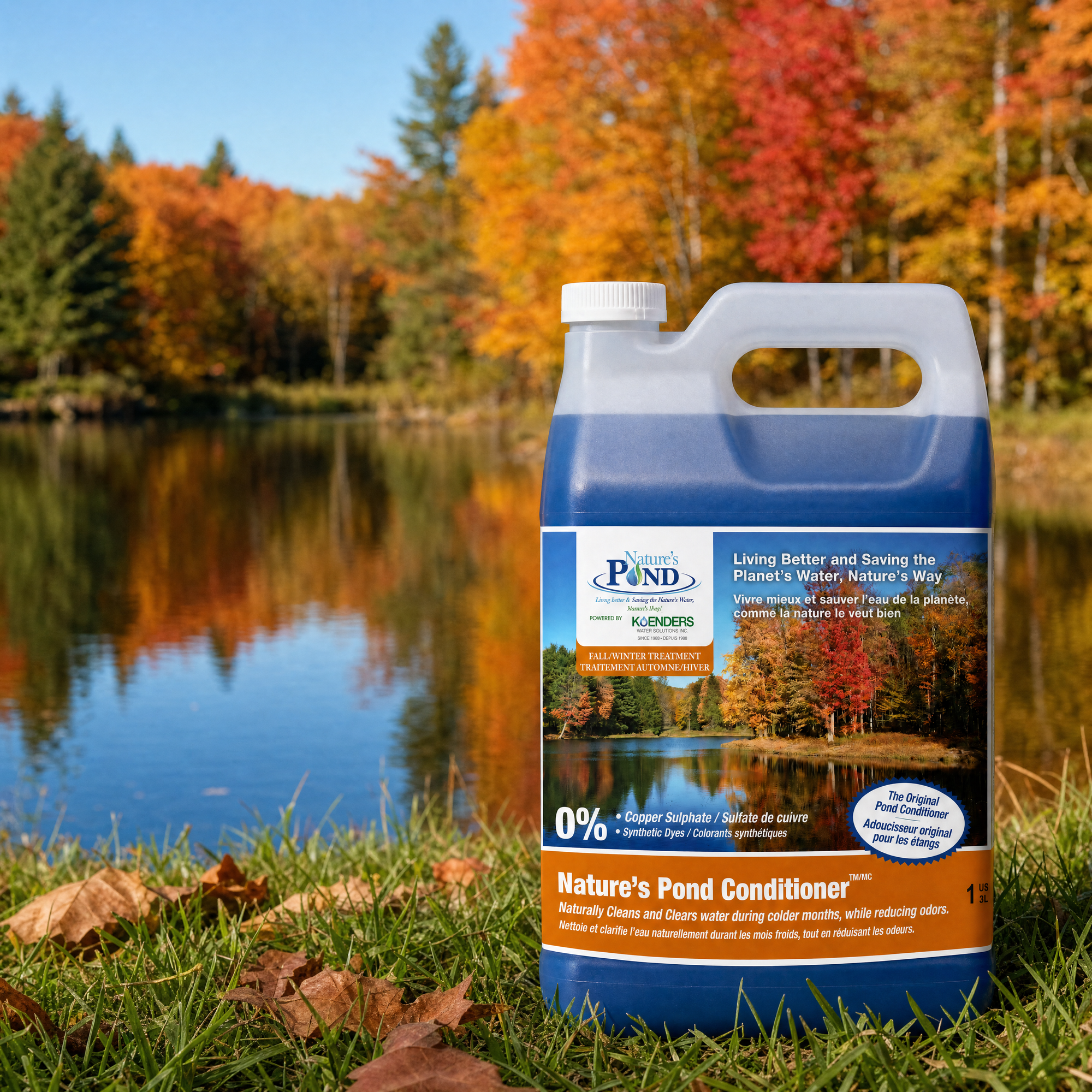
Winter aeration also works best as part of a year-round plan. The durable fix for the muck and nutrients that cause the oxygen problem in the first place is our three-step approach: Renew (condition the water with beneficial bacteria), Revive (aerate), and Remove (mechanical and biological cleanup). Aeration is the Revive step, and it is far more effective when you have also cut the organic load feeding the oxygen demand. Our Nature's Pond Conditioner is an all-natural blend of aerobic and anaerobic beneficial bacteria, enzymes, and plant extracts, safe for fish, pets, livestock, and wildlife when used as directed.
So which one should you buy?
If you keep fish and can buy only one, buy the aerator. It delivers the oxygen that keeps fish alive, helps hold a hole open, and costs far less to run than a de-icer. Choose a de-icer as your single tool only if you have no fish and simply want a guaranteed open patch for off-gassing, or run both if your winters are severe. We never promise any system will keep a whole pond open or eliminate winterkill risk, but a correctly sized aerator is the single most effective thing most pond owners can do before the ice arrives.
Not sure how to size it? That is what our in-house pond experts are for. Tell us your surface area, depth, fish load, and climate, and we will recommend a winter setup at no cost.
Related
- How to prevent winter fish kill Keep a hole open in pond ice safely
- Winter aeration systems Continuous, weather-independent oxygen
- De-icers and accessories Add a hole-opener for extreme cold
- Koi and ornamental ponds Winter care for valuable stocked fish
- Cottage ponds Seasonal ponds that sit unattended
- Talk to a pond expert Free winter setup recommendation
FAQ