 Canada
 United States
Sector guide
Protecting Your Irrigation Pond: Stop Algae, Clogged Intakes and Pump Damage
Algae clogging your intake screens, emitters and pump? Stop it at the source by aerating the reservoir instead of only filtering downstream.
Last updated August 31, 2026
To stop algae clogging an irrigation system, treat it at the source rather than only filtering downstream. Aerate the reservoir so aerobic bacteria can digest the nutrients and organic muck that feed algae and biofilm, add beneficial bacteria to speed that along, and keep an intake screen as a backstop. Cleaner source water means fewer clogged emitters, screens and pumps.
How to stop algae from clogging your irrigation system
If you draw irrigation water from a pond, dugout or reservoir, you already know the pattern: screens blind over, emitters plug, and the pump loses prime or burns out chasing flow through a bed of green slime. The common reflex is to bolt on more filtration downstream. That helps, but it treats the symptom. The water leaving your reservoir is only as clean as the water in it, and a nutrient-rich, poorly mixed pond keeps growing the very algae and biofilm you are straining out.
The durable fix is source control: change the conditions in the reservoir so algae has less to feed on and less reason to bloom. Aeration is the foundation. By oxygenating the bottom and circulating the water column, it lets aerobic bacteria digest the nutrients and organic muck that fuel blooms, so there is less algae and biofilm reaching your intake in the first place. Screening and filtering then become a backstop rather than your whole defence. If you want the full mechanism, our complete guide to pond aeration walks through how bottom-up aeration works.
Filtration catches algae after it grows. Aeration changes the reservoir so less algae grows in the first place.
Why intakes, emitters and pumps clog in the first place
Almost every irrigation clog traces back to the same root cause: a reservoir with too many nutrients, too little oxygen, and not enough circulation. Phosphorus and nitrogen from runoff, decaying vegetation, and bottom sediment feed algae. When the pond is stagnant and the bottom goes low in oxygen, that sediment becomes a slow-release nutrient bank and algae and biofilm thrive.
That biological load is what actually reaches your equipment. Suspended algae blinds intake screens, stringy filamentous algae wraps foot valves, and biofilm, the slimy bacterial film that coats submerged surfaces, builds inside emitters and drip lines where flow is slow. Drip and micro-irrigation are especially unforgiving because their tiny orifices plug on a fraction of what a big sprinkler tolerates.
- Intake screens blind over with suspended and filamentous algae, starving the pump of flow.
- Emitters and drip lines plug with biofilm and fine algae fragments that survive coarse screening.
- Pumps cavitate, lose prime, and overheat when they cannot pull rated flow through a fouled intake.
- Filters and sand media clog faster and need backwashing more often when the source water is bloom-heavy.
Source control beats bolt-on filtration
Filters and screens are necessary, but on their own they are an endless consumable: the pond keeps producing algae, and you keep straining it out. Shifting the work upstream, to the reservoir itself, reduces the load before it ever reaches the pump.
Aeration: oxygenate the bottom so muck is digested, not accumulated
Bottom-up diffused aeration lifts low-oxygen water off the pond floor and mixes the whole column, which keeps the sediment aerobic. In an oxygen-rich bottom, aerobic bacteria break organic muck down toward carbon dioxide and water instead of letting it pile up and release nutrients. Destratifying the pond this way also removes the stagnant, warm surface layer that algae love. Bottom-diffused aeration outperforms surface aeration for this because it reaches and reconditions the sediment where the nutrient problem actually lives. You can browse electric diffused aeration systems sized for reservoirs, and where a power line does not reach the water, off-grid windmill and solar options run the same diffuser without a trench.
Beneficial bacteria: lower the nutrient load that feeds the bloom
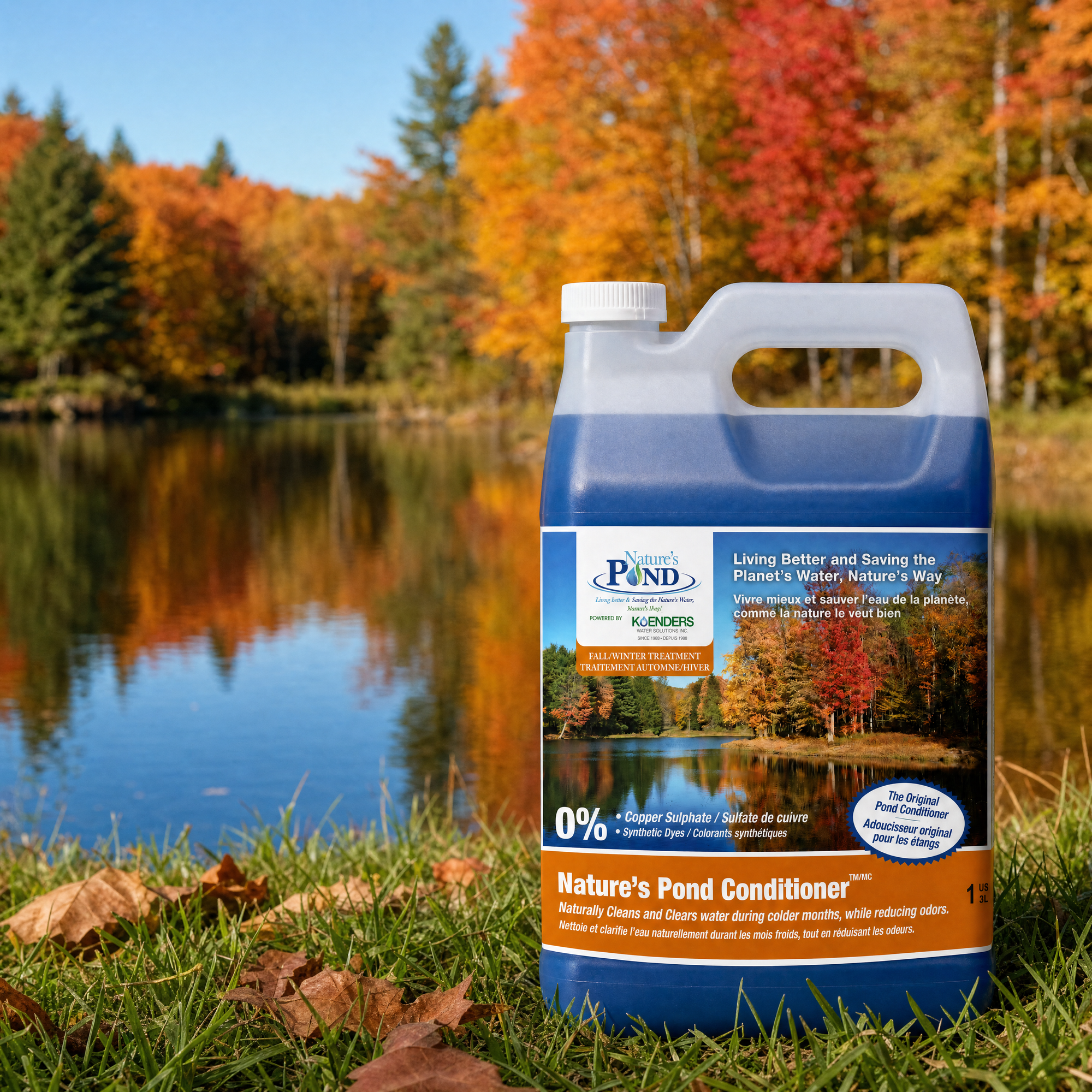
Aeration sets the stage; beneficial bacteria do the digestion. Nature's Pond Conditioner is an all-natural blend of aerobic and anaerobic beneficial bacteria, enzymes, and plant extracts with a food-grade dye. The bacteria and enzymes consume the organic sediment and excess nutrients that algae feed on, converting organics to carbon dioxide and water. It is non-pathogenic and, used as directed, is safe for fish, pets, livestock and wildlife, which matters when the same reservoir waters a herd or a garden. Because the bacteria are aerobic, they work fastest in oxygenated water, so pairing them with aeration is not optional, it is what makes the biology work.
Intake screening as a backstop, not the whole answer
Keep the screen, but let it do less. A well-designed intake, screened, sized to keep entrance velocity low, and drawn from mid-column rather than off the bottom or the surface scum layer, catches what source control misses. When the reservoir is aerated and biologically maintained, that screen blinds over far less often, backwash cycles stretch out, and the pump runs closer to its rated duty.
Aeration and biology vs chronic algaecide
Many growers reach for copper sulfate when the intake plugs. It kills algae fast, but the dead algae then sinks, rots, consumes oxygen, and releases the nutrients that feed the next bloom, so you dose again and again. Copper also accumulates in the sediment over repeated seasons. An aeration-plus-biology program targets the cause instead, so it is durable and, over a multi-year horizon, usually lower in lifetime cost than chronic chemical dosing. The table below compares the three approaches.
| Aeration + beneficial bacteria (source) | Intake screen / filter (downstream) | Chronic algaecide | |
|---|---|---|---|
| Addresses the cause | Yes | No | No |
| Protects emitters and pump | Yes, reduces the load upstream | Partly, catches debris only | Temporarily, rebounds |
| Lifetime cost | Lower, mostly one-time plus energy | Ongoing consumables and labor | Repeat dosing every season |
| Fish and water safety | Safe when used as directed | Neutral | Oxygen-crash risk from algae die-off |
Sizing aeration for an irrigation reservoir
The right aeration for your reservoir depends on three things: surface area in acres, average depth, and whether a power line reaches the water. Depth matters as much as surface area, because a deeper diffuser has to push against more back pressure and a stratified deep pond needs the whole column mixed, not just the top. A long or irregular reservoir also needs diffusers spread to circulate the entire basin rather than a single unit in one corner.
One important safety note: if your reservoir is already stratified into a warm top and a cold, oxygen-poor bottom, do not switch a strong bottom diffuser to full continuous run all at once. Doing so can mix the low-oxygen bottom water through the whole pond in one shot. Ramp runtime up over one to two weeks so the layers blend gradually. Rather than guess at CFM and diffuser count, contact our pond experts for a free sizing estimate: give us your surface acres, average depth, and power situation and we will recommend a matching system.
- Measure the reservoir: surface acres and average depth (acre-feet equals surface acres times average depth).
- Note power access at the water, so we can steer you to electric, solar, or off-grid windmill.
- Map the shape, a long or lobed basin needs diffusers spread out to circulate the whole pond.
- Request a free estimate so the system is sized to your depth and layout, not a blanket number.
For golf and ag: protecting the irrigation source
On a golf course, the hazard pond and the irrigation pond are often the same waterbody, so the superintendent is protecting playability and the irrigation source at once. The same logic applies to farm reservoirs, orchard ponds, and vineyard supply dugouts: cleaner source water means fewer plugged emitters, less pump downtime, and less time spent pulling and cleaning screens in peak season. For the course-specific playbook on aesthetics, algae and odor control, see our golf course pond management guide, and if you manage golf-course ponds or supply water to aquaculture and fish farms the sizing conversation is the same. If you are still deciding between a surface display unit and a bottom diffuser, our aerator versus fountain comparison explains why a fountain oxygenates only the top few feet while a diffuser reconditions the bottom where the nutrient load sits.
Clear the source: aeration plus bacteria
Stop fighting the same clog every season. Aerate the reservoir so aerobic bacteria digest the nutrients algae feed on, add beneficial bacteria to accelerate it, and let your intake screen be the backstop it was meant to be. It is the durable, lower-lifetime-cost path to fewer plugged emitters, steadier pump flow, and cleaner water on the field. When you are ready, tell us about your reservoir and we will size a system to your acreage, depth and power access at no charge.
Related
- The complete guide to pond aeration How bottom-up aeration actually works
- Aerator vs fountain Why a fountain leaves the bottom untouched
- Golf course pond management Aeration, algae and odor for superintendents
- Electric aeration systems Diffused aeration sized for reservoirs
- Pond conditioner (beneficial bacteria) Digests the nutrients algae feed on
- Free sizing estimate We size a system to your reservoir
FAQ